India in Jewels – A Coversation with Dr. Usha R. Balakrishnan
India’s jewellery traditions are among the most captivating chapters in its dazzling history. In this country, sparkle is woven into everyday life—into celebrations, religion, and art. As I prepare to travel to IIJS Premiere—the major jewellery trade show in Mumbai kicking off on July 30th—I’m diving deeper into India’s rich cultural heritage. And when it comes to learning, why not go straight to the source? That’s why I’ve invited the incomparable Dr. Usha R. Balakrishnan—renowned historian, curator, and expert in India’s jewellery traditions—to share her extraordinary insights with the Blingsis community.
——

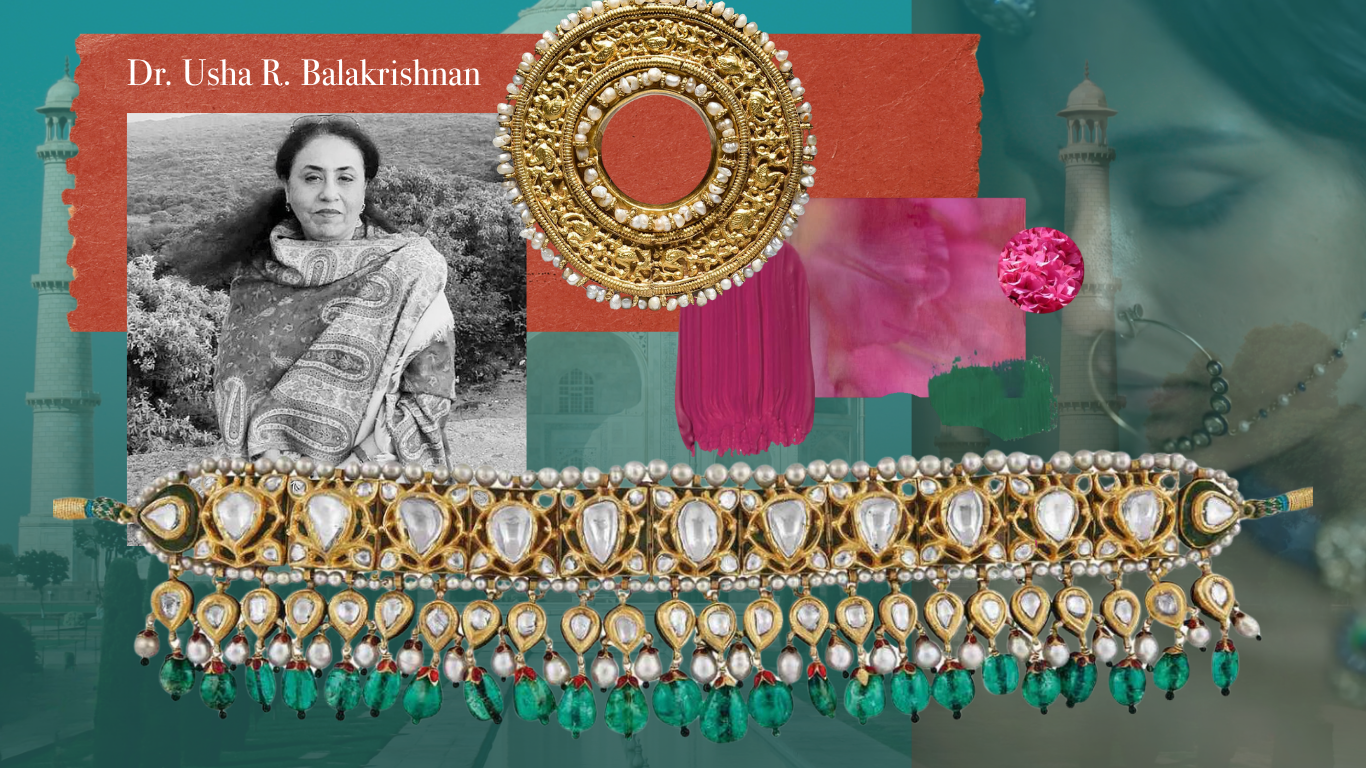
Dr. Usha R. Balakrishnan
Why has jewellery held such deep cultural and social significance in Indian history?
To be unadorned is to be invisible. Jewels complete the human persona – they signify gender, caste, religion, and status. Adornment gives an individual a place in the social and cosmic order.
Could you share a bit about your own journey—what sparked your passion for the history of Indian jewellery?
Academically, I studied Ancient Indian Culture and Museology. I was fascinated by the ancient gemstone trade, the Golconda mines, and the overall lack of documentation in this field. My passion began at a young age—privileged visits to temples, seeing temple jewellery, and watching the bench jeweller create pieces for my grandmother at home. I watched him craft my diamond earrings, necklace, and ring—piece by piece. It was mesmerizing, meditative, and deeply educational. That experience ignited my passion for jewellery, instilled deep respect for artisans, and made me appreciate India’s unmatched legacy in the world of gems and jewels.
India is known for extraordinary craftsmanship—what metals, gemstones, and techniques are traditionally its strongest specialties?
Gold and silver – gold for the affluent and silver among rural communities. Diamonds belong to India and were the most favoured. Emeralds from Colombia, and rubies and spinels from Burma and Sri Lanka were also preferred. Techniques vary across India. For example, in Rajasthan, kundan gem-setting and meenakari enamelling are popular; in parts of South India, closed gem-settings and repoussé work are common; in Gujarat, filigree and granulation techniques stand out. Every region in India is known for its unique jewellery traditions. India is not a homogenous geographical space, but a tapestry of many cultures and traditions coexisting harmoniously—constantly influencing one another. Each region therefore has its own distinct jewellery designs, techniques, symbols, and forms that stand out for their individuality.
Jewellery plays a key role in Indian festivals. What’s the deeper cultural or spiritual meaning behind that?
Festivals in India are both social and religious occasions. Some, like Diwali and Akshaya Tritiya, revolve around themes of wealth and good fortune. In this context, gold plays a significant role. It is considered ritually pure and highly auspicious. Acquiring gold during festivals symbolizes Lakshmi, the goddess of wealth, and is believed to bring prosperity to the family.

Your Instagram often features stunning depictions of bejewelled goddesses. Can you share the meaning behind their adornments?
According to Hindu philosophy, the Ultimate Reality—Brahman—is nirguna, meaning formless, invisible, and without attributes. Through jnāna (knowledge), this Brahman is realized and becomes saguna, assuming form and becoming visible. By adorning divine images with clothes and jewels, the gods take on an earthly persona. Hence, abharana, or the ritual adornment of icons with clothes, flowers, and jewellery, is a vital part of worship.
In your view, what is the most precious jewel in India’s history? Perhaps you could also share what is the most exceptional or unusual jewellery piece you’ve encountered in your research or curatorial work?
Much of India’s historical jewellery has been lost—melted down, looted, or sold. That’s a tough question—preciousness can be defined by value, history, or symbolism. Some would say the Kohinoor diamond, largely due to the myths and stories surrounding it. I had the privilege of documenting the Nizam of Hyderabad’s jewel collection—every item was exceptional. I’ve worked with museums and private collectors worldwide and encountered many extraordinary pieces. The survival of Indus Valley and Taxila jewellery (which I curated for the National Museum, New Delhi) was truly remarkable. Seeing, handling, and studying jewels over 4,000 years old was a very special experience.
Were there any iconic style-setters in Indian history—royals, queens, or historical figures—who could be seen as early jewellery “influencers”?
Every sculpture in history adorned with jewellery was a style-setter. Terracotta images from Chandraketugarh, the Pala-Sena sculptures, and Chola bronzes all serve as examples. During the Mughal period, Shah Jahan and later maharajas and maharanis played this role. Notable names include Maharaja Yadavindra Singh of Patiala, Jagatjit Singh of Kapurthala, Sita Devi of Baroda, and Indira Devi of Kapurthala, among others.

Cartier in India – Maharaja Yadavindra Singh of Patiala wearing the necklace designed and created by Cartier in 1928. The piece had been commissioned by his father, Sir Bhupindra Singh.
Indian bridal jewellery is incredibly rich and symbolic. What are the historical roots of these styles?
Indian bridal jewellery is rooted in the concept of Solah Shringar (the 16 adornments) for the bride. Jewels from head to toe are considered essential—each with deep symbolic meanings related to luck, prosperity, fertility, equanimity, and more—as the young bride prepares herself for a new and challenging role in life.
Can you walk us through the key elements of a traditional bridal jewellery ensemble?
A traditional Indian bridal ensemble begins with the maang tikka (forehead ornament), followed by the nath (nose ring), jhumkas (earrings), and haar (necklaces of varying lengths). This continues with the bazuband (armlets), chooda or kadas (bangles), haathphool (hand chains), kamarband (waist belt), payal (anklets), and finally the bichua (toe rings), which signify marital status. Of course, the terminology, designs, and choices vary from region to region and community to community.
What values or symbolic meanings are woven into bridal jewellery designs?
Apart from the mangalsutra (marriage necklace), which must align with the design and tradition of the groom’s community, symbolic meanings have become limited in today’s context. However, every region still retains its own distinct wedding jewellery styles, though elaborating on all of them here would be difficult.
Indian men—both historical and modern—are known for embracing jewellery. What are the most iconic pieces traditionally worn by men?
The most fabulous jewels were the privilege of maharajas in royal courts. Traditionally, men wore earrings—ears were pierced at a young age, as the point is believed to enhance learning and fertility. Turban ornaments (especially visible during durbars), armbands for their amuletic value, rings, bracelets, jewelled belts, and bejewelled daggers tucked into the waist were all common. Today, men are increasingly embracing jewellery, with brooches becoming especially popular.

The Museum of Meenakari Heritage (MoMH) in Jaipur
For anyone wanting to explore India’s jewellery heritage firsthand, what museums or collections are absolute must-visits?
The Museum of Meenakari Heritage, Jaipur; Amrapali Museum, Jaipur; National Museum, New Delhi; Victoria & Albert Museum, London; The British Museum, London; The David Collection, Copenhagen; Musée Guimet, Paris; Khalili Collection, London—these are just a few that come to mind.
This year’s IIJS Premiere theme is Indian architecture. What are some creative or historical links between architecture and jewellery design in India?
Almost every piece of jewellery can be seen as architectural—built with precision, proportion, and symbolic geometry. Temple spires, facades, and architectural motifs often appear in jewellery design, especially in the popular repoussé gold ‘temple jewellery’ style.
What current projects are you working on—books, exhibitions, or upcoming lectures we should know about?
I often work on multiple projects simultaneously. I’ve completed a book on the Amrapali collection, which will be published soon. I’m also working on two more books and curating another museum. (I previously curated the Meenakari Museum in Jaipur and the Jewellery Gallery at CSMVS, Mumbai.) One particularly exciting project is underway—but I’m not yet at liberty to disclose details. It will make waves in the jewellery world!
——————

Dr. Usha R. Balakrishnan
EXPERT’S BIO:
Dr. Usha R. Balakrishnan, based in Mumbai, is a highly regarded independent scholar and historian specializing in Indian art and jewellery. With a Ph.D. in Ancient Indian Culture and a post-doctoral degree in Museum Studies from New York University, her expertise is unparalleled. Her seminal works include Dance of the Peacock: Jewellery Traditions of India, reflecting India’s 5,000-year history of adornment, and Jewels of the Nizam, a government-commissioned documentation of the Nizam of Hyderabad’s royal treasures. Other publications include Diamonds Across Time, Enduring Splendor: Jewelry of India’s Thar Desert, India: Jewels That Enchanted the World, Treasures of the Deccan, among others. Silver & Gold: Visions of Arcadia – The Amrapali Collection of Indian Jewellery is forthcoming.
Usha’s contributions extend to curating significant exhibitions and museum galleries, such as the Museum of Meenakari Heritage in Jaipur, Shringara: Adornment at Mumbai’s CSMVS Museum, Enduring Splendor at UCLA’s Fowler Museum, and Meditations in Gold at the Flint Institute of Arts. She has also been instrumental in organizing jewellery conferences and offering insights into India’s vast and ancient jewelled heritage.
—